Word Association Sort: Puzzle
Hippo LabWord
4.7121.00 Reviews
- Version
- 2.6.4
- Installs
- 50.00K
- Age Rating
- Everyone
Screenshots
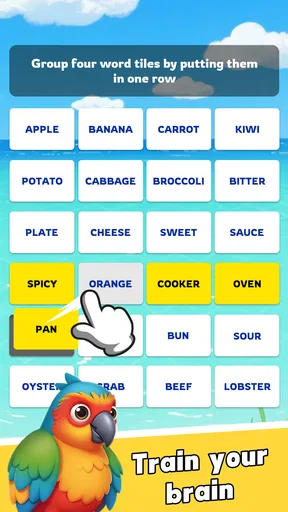
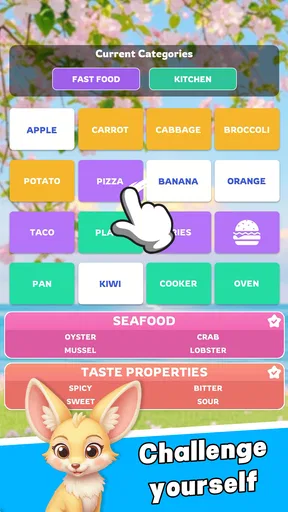
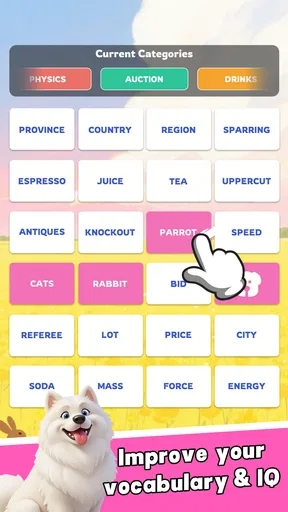
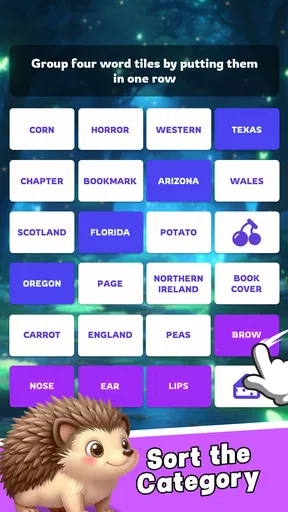
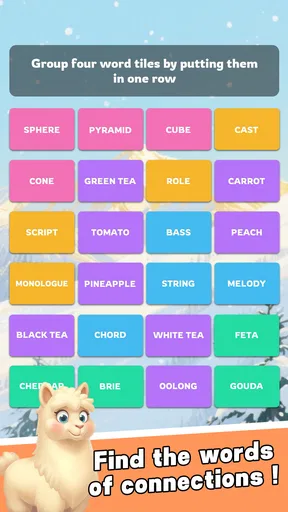
Our Review of Word Association Sort: Puzzle
 Analysis by Appyee
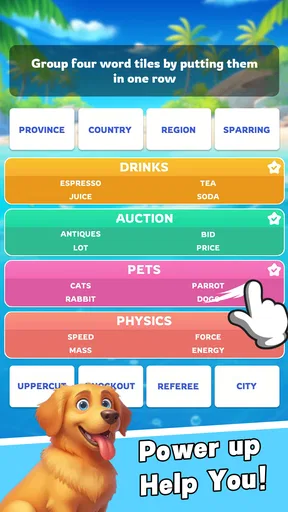
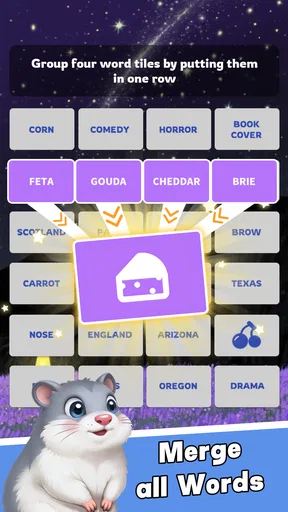
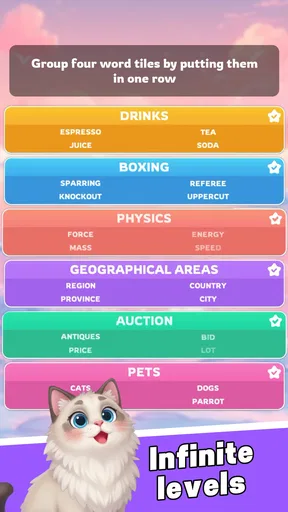
I enjoy word games that make me pause for a few seconds before the answer suddenly becomes obvious. Word Association Sort: Puzzle takes that small moment of discovery and builds the whole experience around it: I sort four words into a shared category, then move on to the next challenge while spending time with a pet companion. It is a free word game from Hippo Lab, aimed at Everyone, and its simple presentation makes it easy to understand almost immediately.
After spending time with it, my impression is that this is best viewed as a compact thinking game rather than a large, story-driven adventure. The appeal comes from recognizing relationships between words, questioning my first assumption, and finding the cleanest grouping. That focus gives it a pleasant rhythm for short sessions, although players looking for deep progression, competitive play, or a constantly changing set of mechanics may find the format narrow.
How I Decide Whether This Puzzle Format Fits
The first question I would ask is whether you like language puzzles that depend on meaning rather than spelling alone. This is not primarily about building long words, racing against a clock, or filling a crossword grid. The central task is to look at four terms and work out what connects them. That makes vocabulary, general knowledge, and flexible thinking more important than fast tapping.
I also consider how much variety I need from a mobile game. A sorting puzzle can be satisfying because its rules stay clear, but that same clarity can become predictable if I want several different modes in one app. Here, the word-association idea is the main attraction, with the pet interaction adding personality around the puzzle. I would choose it for focused, low-pressure play, not as a replacement for a broad collection of word-game styles.
Another useful decision point is session length. I can imagine opening it while waiting for an appointment, taking a short break from work, or relaxing before bed. The individual challenge structure suits those moments better than a game that expects a long uninterrupted commitment. If you prefer games that remember a large ongoing world, offer elaborate missions, or demand a detailed strategy plan, this more concentrated design may feel modest.
The audience positioning is refreshingly broad. Because the content rating is Everyone, I would feel comfortable considering it for family use, although the actual enjoyment will still depend on vocabulary level and patience. Younger players may need help with less familiar words, while adults can use the puzzles as a light mental break. It is also a reasonable choice for someone who wants a word game without an intimidating interface or complicated rules.
The small skill that makes the biggest difference
My most useful approach is to avoid locking onto the first connection I see. Four words can appear to belong together because of a broad theme, but a stronger solution usually uses a more precise relationship. I mentally test each possible group against every word, asking whether the category applies naturally or only through a forced interpretation. This turns the game from guessing into a process of elimination.
A second helpful habit is to separate familiar words from misleading ones. If three terms clearly share a relationship, I do not immediately move them together unless the fourth word fits with equal strength. I first look at the remaining terms and search for the category that becomes possible after removing the obvious-looking option. That method is especially useful when two groups overlap in a loose, everyday sense.
I also recommend treating the pet interaction as a pacing tool rather than letting it distract from the language challenge. A quick interaction after solving a puzzle can make the session feel warmer, but the core satisfaction still comes from the grouping itself. Players who enjoy collecting or caring for a companion may appreciate that extra layer; players who want only rapid-fire puzzles may see it as a pause between the parts they came for.
Where the game feels strongest
The clearest strength is its immediate readability. I do not need to learn a complicated control system before I can understand the objective. Four words, one category decision, and a simple interaction loop create a low barrier to entry. That matters on a phone, where I often want to start playing without studying instructions or navigating several menus.
The format also rewards a kind of thinking that feels more thoughtful than reflex-based. I can take a moment, compare meanings, and revise an assumption. That makes it suitable for quiet play and for people who enjoy language as a form of pattern recognition. The challenge is not only knowing words; it is noticing which relationship is intended to be the most exact.
In everyday use, I would open it during a short lunch break. I might solve one puzzle quickly, get stuck on another, and leave it for later rather than feeling forced to finish immediately. When I return, the unresolved group gives me a fresh angle. That stop-and-start quality is valuable because it turns a few spare minutes into a complete activity instead of beginning a game that needs a long session.
The pet element gives the experience a friendlier tone than a bare list of word problems. It does not change the fundamental puzzle, but it can make repeated sessions feel less sterile. For a player who likes a little emotional or visual companionship around a simple task, that addition may be enough to make this more inviting than a plain word-sorting utility.
What I would watch during play
The same focused design that makes the game approachable can limit its appeal over time. If I want an app that alternates between anagrams, crosswords, spelling challenges, and trivia, this will not provide that broad menu. Its identity is tied closely to association and categorization. I would rather choose it knowingly than expect it to become a general-purpose word-game collection.
There is also a natural frustration point in association puzzles: the player and the puzzle may be using different ideas of what counts as a category. When my interpretation is reasonable but not intended, the experience can feel less like a test of vocabulary and more like trying to predict the author’s logic. I find that tolerable when the intended grouping is precise, but it is the main issue I would keep in mind if ambiguous wording bothers you.
The pet interaction may divide players as well. It adds charm, but someone who wants a purely efficient puzzle session may prefer fewer decorative interruptions. Conversely, someone choosing the game mainly for the companion element should remember that the word task remains the center of the experience. I would not install it expecting a full pet-simulation game.
The game is free to install, with in-app purchases ranging from $0.99 to $29.99 per item. That makes the initial decision easy, but I would still pay attention to how optional purchases fit my own habits. For casual players, the free entry point may be enough to judge the format. Anyone who tends to spend quickly when stuck should decide on a personal limit before playing, especially in a puzzle game where the desire for an immediate solution can be strong.
Choosing It Instead of Another Word Game
Compared with crossword-style games, this offers a more compact decision each time. A crossword usually asks me to manage intersecting clues and a larger grid, while this concentrates attention on a small group of words. I would choose the sorting format when I want a clean mental exercise without committing to a full page of clues. I would choose a crossword alternative when I enjoy gradual construction, spelling precision, and the satisfaction of seeing a grid fill up.
Compared with anagram games, the emphasis is different again. Anagrams reward rearranging letters and recognizing possible spellings. Here, I am looking for meaning and relationships between separate terms. Someone who loves manipulating letters may find more direct satisfaction elsewhere, while a player who enjoys themes, categories, and semantic connections will likely feel more at home with this design.
Trivia games can offer a wider range of factual subjects, but they also tend to judge whether I know a particular answer. This puzzle format feels more interpretive: I may know all four words and still need to identify the intended connection. That makes it a better choice for players who enjoy reasoning from familiar information rather than simply recalling facts.
Compared with a plain puzzle app with no character element, the pet gives this game a softer personality. The trade-off is that the experience is not as stripped down. If I want the most direct route from opening the app to solving a challenge, a minimal alternative may suit me better. If I like a little companionship and visual warmth around the wordplay, this has a clearer advantage.
Who should make the switch
I would recommend trying it if you enjoy short word challenges, often notice hidden categories in ordinary language, and want something that can fit around a busy day. It is particularly suitable for players who prefer thinking at their own pace instead of competing against a timer or another person. The broad age rating and straightforward premise also make it worth considering for shared family play, provided everyone is comfortable with the vocabulary.
I would be more cautious if your main goal is long-term strategic depth. Sorting four words is elegant, but elegance is not the same as variety. Players who need extensive progression systems, multiplayer competition, or several puzzle formats may outgrow the central loop. In that case, I would use this as a light companion game rather than my only word title.
It is also not my first recommendation for someone who dislikes subjective categories. The best experience comes from accepting that the puzzle asks for the strongest common relationship, not every possible relationship. If that kind of interpretation feels unfair or irritating, a spelling-based game with more mechanically fixed answers may be a better fit.
What changes when you move from another game
Switching from a crossword or anagram game should be easy at the control level because the concept is quickly understandable. The bigger adjustment is mental: I have to stop searching for letters and start comparing meanings. I would give myself a few sessions to learn the game’s preferred level of category precision before deciding whether it suits me.
Moving from a trivia app requires a different expectation too. I am not simply proving that I know an answer; I am testing several possible links and deciding which one groups the words most convincingly. That makes mistakes useful when I review why my first category was too broad. I find that reflective process more satisfying than instantly checking whether a fact was remembered correctly.
The cost of switching is low because the game is free to try, but the practical cost is attention. If I already have several daily word games, this may compete for the same small pockets of time. I would keep it installed if its association puzzles feel distinct enough from my current routine. If it merely duplicates the kind of thinking I already get elsewhere, the pet and presentation would need to be meaningful reasons to stay.
The developer is Hippo Lab, and the current version is 2.6.4. It runs on Android 7.0 or later, which keeps it accessible to people using older supported devices. Its average rating is 4.8 from around 1.6 thousand ratings, and it has passed 50 thousand installs. Those signals suggest that the focused concept has found an audience, though they do not replace my own test of whether the category logic feels satisfying.
My recommendation after using it
I recommend Word Association Sort: Puzzle to anyone who wants a friendly, focused word game built around categorization rather than letter manipulation. Its best qualities are the quick learning curve, the thoughtful pause before each answer, and the pet interaction that gives the routine a little personality. I especially like it for short breaks when I want to exercise my attention without starting an elaborate game.
I would not present it as the universal choice for word-game fans. Its narrow central mechanic is also its defining limitation, and the companion element will not replace deeper progression for players who want a larger experience. The possibility of in-app purchases is another reason to play with a clear spending boundary rather than treating every obstacle as a prompt to buy something.
For me, the deciding test is simple: do I enjoy comparing meanings and finding the most exact shared category? If yes, the game gives that habit a pleasant mobile form. If I prefer constructing grids, rearranging letters, answering factual questions, or competing directly with others, another category of game will probably serve me better. As a free download with an Everyone rating, it is easy to try, and I think it earns that trial when you want calm, compact wordplay with a small pet-focused touch.
Verdict
Strengths of Word Association Sort: Puzzle
- Simple rules make it easy to start playing immediately.
- Short levels fit well into quick breaks or casual play sessions.
- Sorting words can help reinforce vocabulary and pattern recognition.
- Progressive challenges keep later puzzles more engaging.
- Clean presentation makes the board easy to read on mobile screens.
Limitations of Word Association Sort: Puzzle
- Some puzzles may depend on subjective word connections.
- Difficulty can feel inconsistent between consecutive levels.
- Repeated categories may reduce the sense of discovery over time.
- Hints or assistance may be limited during especially tricky puzzles.
- Players seeking action or rich visuals may find the gameplay too minimal.
Other Releases by Hippo Lab
View All
Snake Lite - Snake Game
Action4.4
Similar Picks in This Category
View All
Word Search - Word Puzzle Game
Bluetile4.8

Word Search Quest - Puzzles
Blackout Lab4.8

CodyCross: Crossword Puzzles
Fanatee, Inc.4.7

Words of Wonders: Crossword
Fugo Games4.9

Wordscapes: Word puzzle game
PeopleFun4.7

Word Search Explorer
PlaySimple Games4.9
Frequently Asked Questions
What is Word Association Sort: Puzzle?
Word Association Sort: Puzzle is a casual word game built around grouping related words into the correct categories. Each level presents a collection of words that may appear confusing or intentionally misleading, so you need to identify their connections and sort them properly. The game is easy to understand, but later puzzles require vocabulary, concentration, and careful reasoning rather than simply quick tapping.
How do you play Word Association Sort: Puzzle?
To play, read all the words shown on the screen and look for four-word relationships or other category patterns suggested by the current level. Tap or arrange words that belong together, then submit your selection to check the answer. Some words can appear to fit multiple groups, which makes it important to consider the entire board before committing. Progress depends on finding the intended associations.
Is Word Association Sort: Puzzle suitable for beginners?
Yes, the game is approachable for beginners because its central idea is straightforward and the early challenges generally help you understand how the sorting system works. However, it is not limited to very young or casual players. As you advance, the puzzles can become more demanding, using wordplay, less obvious connections, and distractors that require a broader vocabulary and more deliberate thinking.
Does Word Association Sort: Puzzle require an internet connection?
The basic puzzle experience may be playable without a continuous internet connection, which is convenient when you want a short brain-training session while traveling or away from Wi-Fi. Nevertheless, connection requirements can vary by version and device, particularly for advertisements, cloud progress, updates, leaderboards, or optional online features. It is best to launch the game once online after installation and review its current permissions and settings.
Is Word Association Sort: Puzzle free to download and does it contain ads?
Word Association Sort: Puzzle is generally offered as a free download, allowing you to try its core word puzzles without paying upfront. Like many free mobile games, it may support itself through advertising and could include optional purchases, such as removing ads, obtaining hints, or unlocking additional content. Before downloading, check the current store listing for the exact in-app purchase details and age-related information.
Play our best games!


